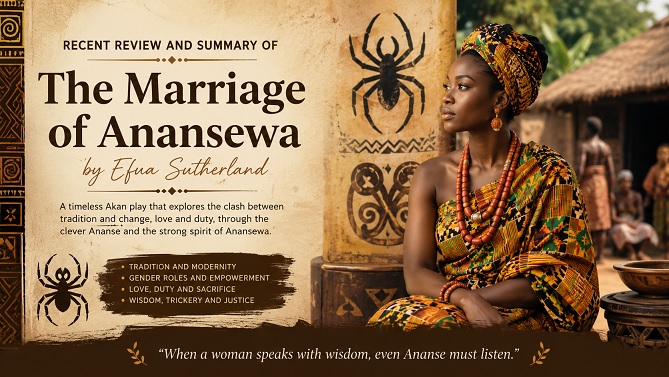
Recent Review and Summary of The Marriage of Anansewa by Efua Sutherland
Introduction
African literature has long served as a powerful medium through which writers preserve cultural traditions, examine societal values, and address the challenges confronting their communities. Among the many literary works that have contributed significantly to the development of African drama, The Marriage of Anansewa by Efua Sutherland occupies a distinguished position. The play is widely regarded as one of the finest examples of modern African drama because it successfully combines indigenous African oral traditions with contemporary theatrical techniques. Through its engaging storyline, memorable characters, and insightful social commentary, the play offers readers and audiences an opportunity to reflect on issues such as marriage, greed, parental authority, social ambition, cultural identity, and the tension between tradition and modernity.
Published in 1975, The Marriage of Anansewa remains relevant decades after its publication because the concerns it addresses continue to exist in many African societies. The play is not merely a story about a father’s attempt to secure a wealthy husband for his daughter; it is a profound examination of human nature and social relationships. Through humor, satire, and dramatic irony, Sutherland explores how individuals pursue wealth, status, and recognition, often at the expense of honesty and morality. The playwright skillfully uses the legendary folkloric character Ananse to expose both the strengths and weaknesses of human behavior.
One of the reasons the play has remained popular among scholars, students, and literary critics is its ability to blend entertainment with education. Readers laugh at Ananse’s clever schemes while simultaneously recognizing the serious social issues embedded within the narrative. This balance between comedy and criticism makes the play a remarkable contribution to African literary studies.
A comprehensive literary review of The Marriage of Anansewa requires an understanding of the author’s background, the historical and cultural environment in which the play was written, and the narrative structure that drives the story. These elements provide the foundation upon which the play’s themes and artistic significance can be fully appreciated.
Background of the Author
The success and enduring relevance of The Marriage of Anansewa cannot be separated from the literary vision of its author, Efua Sutherland. Born on June 27, 1924, in Ghana, Sutherland emerged as one of Africa’s most influential playwrights, dramatists, educators, and cultural activists. Her contribution to African literature extends beyond her creative works, as she played a vital role in promoting indigenous African cultural expressions and encouraging the development of a distinctly African theatrical tradition.
During a period when many African writers sought to reclaim cultural identities that had been marginalized during colonial rule, Sutherland dedicated her career to preserving and revitalizing traditional African storytelling methods. She believed that African literature should draw inspiration from local experiences, folklore, customs, and oral traditions rather than relying exclusively on Western literary models.
Her literary works consistently reflect her commitment to cultural preservation. She recognized the importance of oral literature as a repository of African wisdom, values, and historical memory. Consequently, she integrated storytelling, songs, audience participation, proverbs, and folklore into her dramatic productions.
Sutherland’s influence extended beyond writing. She was actively involved in educational and cultural initiatives aimed at promoting literacy and artistic development. Her efforts contributed significantly to the growth of Ghanaian theatre and the broader African literary movement.
Among her most celebrated works are Edufa, Foriwa, and The Marriage of Anansewa. However, it is The Marriage of Anansewa that has achieved perhaps the widest recognition due to its accessible style, compelling narrative, and insightful social commentary.
Sutherland’s ability to transform traditional folktales into sophisticated dramatic works demonstrates her literary brilliance. By adapting the legendary trickster Ananse into a modern context, she created a play that appeals to both African and international audiences. Her work continues to be studied in universities and secondary schools across Africa and beyond, confirming her status as one of the continent’s literary pioneers.
Historical and Cultural Context of the Play
Understanding the historical and cultural context of The Marriage of Anansewa is essential for appreciating its deeper meanings. The play emerged during a period of significant social transformation in many African countries. Following independence from colonial rule, nations such as Ghana were engaged in the process of redefining their identities and balancing traditional values with modern influences.
The decades following independence witnessed rapid urbanization, increased access to formal education, economic changes, and the expansion of Western cultural influences. These developments affected various aspects of African life, including marriage practices, family structures, social relationships, and cultural beliefs.
Traditional African societies often regarded marriage as more than a union between two individuals. Marriage was viewed as an alliance between families and communities. Consequently, decisions concerning marriage frequently involved parents, elders, and extended family members. Factors such as social status, wealth, family reputation, and cultural compatibility often played important roles in determining suitable marriage partners.
However, modernization introduced new ideas regarding personal freedom, romantic love, and individual choice. As a result, tensions began to emerge between traditional customs and contemporary values. These tensions form an important backdrop to the events depicted in The Marriage of Anansewa.
The play also reflects the economic realities of postcolonial African societies. Financial struggles, aspirations for social mobility, and the desire for economic security influence the decisions of several characters. Ananse’s schemes can be understood partly as a response to these social and economic pressures.
Furthermore, the play draws extensively from Akan culture, one of the major cultural traditions in Ghana. Akan society possesses a rich heritage of folklore, proverbs, storytelling, and communal values. The figure of Ananse occupies a central position within Akan folklore and serves as a symbol of intelligence, cunning, adaptability, and opportunism.
By incorporating elements of Akan culture into the narrative, Sutherland creates a work that celebrates African heritage while also subjecting certain cultural practices to critical examination.
The Significance of Ananse in African Folklore
A major feature that distinguishes The Marriage of Anansewa from many other African plays is its use of the legendary character Ananse. To fully understand the play, one must appreciate the cultural significance of this folkloric figure.
Ananse, often depicted as a spider or a human-spider hybrid, is one of the most popular characters in West African folklore. His stories have been told for generations and continue to occupy an important place in African oral traditions.
Traditionally, Ananse is portrayed as a clever trickster who relies on intelligence rather than physical strength to achieve his objectives. He frequently outwits stronger opponents through cunning, deception, creativity, and strategic thinking. While his actions often produce humorous outcomes, they also convey important moral lessons.
Ananse is neither entirely good nor entirely evil. Instead, he represents the complexity of human nature. His strengths include intelligence, resilience, adaptability, and resourcefulness. At the same time, his weaknesses include greed, selfishness, dishonesty, and excessive ambition.
In The Marriage of Anansewa, Sutherland modernizes the Ananse figure by presenting him as a contemporary office clerk struggling to improve his financial situation. Although he lives in a modern setting, he retains many of the characteristics associated with the traditional folkloric Ananse.
This adaptation allows Sutherland to demonstrate that the traits represented by Ananse remain relevant in contemporary society. Through his actions, readers are encouraged to reflect upon the moral implications of pursuing personal gain through manipulation and deceit.
The Dramatic Structure of the Play
One of the most remarkable aspects of The Marriage of Anansewa is its innovative dramatic structure. Rather than following conventional Western theatrical models, the play incorporates elements of African oral performance traditions.
The story is guided by a storyteller who functions as both narrator and commentator. This narrative technique reflects the traditional role of storytellers in African communities, where stories are often performed rather than merely recited.
The storyteller serves several important functions. First, the narrator provides background information that helps audiences understand the unfolding events. Second, the storyteller creates suspense by controlling the pace of the narrative. Third, the storyteller establishes a direct relationship with the audience, encouraging active engagement with the story.
This interactive approach differs significantly from many Western dramatic traditions, where audiences typically observe events from a distance. In contrast, Sutherland’s use of the storyteller fosters a communal atmosphere reminiscent of traditional African storytelling sessions.
The play also incorporates songs, chants, audience participation, and ceremonial performances. These elements contribute to the authenticity of the dramatic experience and reinforce the connection between the play and African oral culture.
Detailed Synopsis of the Play
At the center of the narrative is George Kweku Ananse, commonly known simply as Ananse. He is an ambitious but financially constrained clerk who dreams of improving his social and economic status. Recognizing the beauty, intelligence, and educational accomplishments of his daughter Anansewa, he devises a plan that he believes will transform the fortunes of his family.
Instead of encouraging a relationship between his daughter and a single suitor, Ananse secretly engages four wealthy chiefs from different communities. He persuades Anansewa to assist him by typing identical letters to each chief, suggesting interest in marriage proposals. Unaware of the deception, the chiefs respond enthusiastically and begin sending gifts, money, and tokens of appreciation.
As gifts continue to arrive, Ananse becomes increasingly pleased with the success of his strategy. His home gradually fills with valuable items contributed by the various chiefs. What initially appears to be a clever plan soon becomes a source of anxiety, however, as each chief begins expecting confirmation of his marriage arrangement.
Faced with the challenge of satisfying four competing suitors simultaneously, Ananse develops an even more elaborate scheme. He announces that Anansewa has died unexpectedly. This shocking news triggers a series of dramatic events as the chiefs travel to pay their respects and demonstrate their commitment to the deceased woman.
The funeral scenes become a critical turning point in the narrative. Through their actions and reactions, the chiefs reveal their genuine feelings and intentions. Eventually, one chief distinguishes himself in a manner consistent with traditional expectations regarding marriage and family obligations.
The final revelation that Anansewa is still alive resolves the central conflict and allows the marriage arrangement to proceed. The conclusion reinforces the importance of cultural values while highlighting the consequences of manipulation and excessive ambition.
Significance of the Title
The title The Marriage of Anansewa appears simple, yet it carries profound thematic significance. On the surface, it refers to the marriage negotiations involving Anansewa. However, the title also symbolizes broader social issues explored throughout the play.
The title draws attention to the institution of marriage as a central social and cultural practice. It highlights the ways in which marriage can become entangled with economic interests, family expectations, and social ambitions.
Moreover, the title emphasizes Anansewa’s role as both an individual and a symbol. Although she is a character within the narrative, she also represents young women whose lives are influenced by societal expectations and parental decisions.
Through the title, Sutherland signals that the play’s concerns extend beyond a single marriage arrangement. Instead, the narrative serves as a broader commentary on the values, priorities, and contradictions present within society.
The Theme of Marriage as a Social Institution
One of the most prominent themes in The Marriage of Anansewa is marriage. The entire narrative revolves around the search for a suitable husband for Anansewa, making marriage the central concern of the play.
However, Sutherland presents marriage not simply as a romantic union between two individuals but as a complex social institution influenced by cultural traditions, economic considerations, and family interests. In many traditional African societies, marriage extends beyond personal affection and involves negotiations between families and communities.
Throughout the play, marriage is portrayed as a process that requires careful deliberation and adherence to cultural expectations. The chiefs who seek Anansewa’s hand do not merely express romantic interest; they engage in customary practices that demonstrate respect for tradition and family structures.
At the same time, the play reveals how marriage can become commercialized. Ananse treats his daughter’s marriage as an opportunity to improve his financial situation. Rather than focusing primarily on Anansewa’s happiness or preferences, he concentrates on maximizing the benefits he can obtain from potential suitors.
This treatment of marriage raises important questions about the extent to which economic considerations should influence marital decisions. Through satire and humor, Sutherland encourages readers to examine whether marriage should be viewed as a sacred institution or a transaction motivated by material gain.
The theme remains relevant in many societies where financial status, social class, and family expectations continue to influence marital choices.
The Theme of Greed and Materialism
Greed serves as one of the most powerful driving forces in the narrative. Ananse’s actions are largely motivated by his desire for wealth, social recognition, and economic advancement.
At the beginning of the play, Ananse is portrayed as an ordinary clerk facing financial challenges. Instead of seeking legitimate means of improving his circumstances, he devises a scheme designed to exploit the generosity of multiple suitors simultaneously.
His decision to engage four chiefs rather than one demonstrates the extent of his greed. He becomes increasingly excited as gifts continue to arrive from each chief. Furniture, clothing, food, and other valuable items gradually accumulate in his household, reinforcing his belief that his strategy is succeeding.
Sutherland uses Ananse’s behavior to criticize excessive materialism. The playwright suggests that an obsession with wealth can cloud moral judgment and lead individuals to engage in dishonest conduct.
The accumulation of gifts symbolizes the seductive power of material possessions. As Ananse acquires more wealth, he becomes more deeply entangled in deception. His greed ultimately forces him to invent increasingly complicated lies to maintain his scheme.
The theme highlights the dangers of allowing financial ambitions to overshadow ethical principles. It serves as a warning against the pursuit of wealth at any cost.
The Theme of Deception and Manipulation
Closely connected to greed is the theme of deception. Nearly every major event in the play is influenced by acts of manipulation and dishonesty.
Ananse’s entire plan depends upon deceiving four different chiefs. He creates the illusion that each chief is the exclusive suitor for Anansewa while secretly encouraging all of them to continue their courtship efforts.
The deception becomes more elaborate when Ananse announces Anansewa’s supposed death. This falsehood represents the climax of his manipulative behavior and demonstrates the lengths to which he is willing to go in order to protect his interests.
Sutherland presents deception as both effective and dangerous. On one hand, Ananse’s intelligence allows him to achieve short-term success. His schemes generate wealth and create opportunities that might otherwise have remained unavailable.
On the other hand, the deception creates anxiety, uncertainty, and moral complications. As the lies multiply, Ananse becomes increasingly vulnerable to exposure.
Through this theme, the playwright explores the ethical implications of manipulation. Readers are encouraged to consider whether intelligence and cunning justify dishonest behavior.
The play ultimately suggests that while deception may produce temporary advantages, it carries significant risks and moral consequences.
The Theme of Social Ambition and Mobility
Another important theme is social ambition. Ananse is not merely interested in wealth; he also desires social advancement and prestige.
His interactions with the chiefs reveal a strong desire to elevate his family’s position within society. By marrying his daughter to a wealthy and influential chief, he hopes to gain access to higher social circles and greater respect.
This aspiration reflects broader social realities. Many individuals seek opportunities to improve their status through education, marriage, business success, or political influence. Sutherland acknowledges the legitimacy of such aspirations while cautioning against pursuing them through unethical means.
Ananse’s ambitions highlight the challenges faced by individuals striving for upward mobility in economically unequal societies. His actions can be interpreted as a response to structural limitations that restrict opportunities for advancement.
However, the play makes clear that ambition must be balanced with integrity. Social mobility achieved through manipulation and deceit remains morally questionable.
The Theme of Tradition and Modernity
One of the most intellectually significant themes in the play is the tension between tradition and modernity.
The narrative unfolds within a society undergoing transformation. Traditional customs coexist with modern institutions and lifestyles. Characters navigate a world where cultural values inherited from the past intersect with contemporary influences.
Anansewa herself represents aspects of modernity. She is educated and capable of using a typewriter, reflecting the increasing importance of formal education and modern skills.
Ananse, meanwhile, combines traditional cunning with modern aspirations. Although he employs strategies associated with the folkloric Ananse figure, he operates within a contemporary social environment.
The marriage negotiations also illustrate the coexistence of traditional and modern practices. Chiefs continue to observe customary marriage procedures even as society evolves.
Sutherland does not portray tradition and modernity as mutually exclusive forces. Instead, she demonstrates that individuals often draw upon both in their efforts to navigate changing circumstances.
This nuanced portrayal encourages readers to consider how societies can preserve valuable cultural traditions while adapting to new realities.
The Theme of Parental Authority
Parental authority plays a significant role throughout the narrative. Ananse exercises considerable influence over his daughter’s life and future.
In many traditional African societies, parents possess substantial authority in matters relating to marriage and family decisions. The play reflects this cultural reality by depicting Ananse as the primary decision-maker in the marriage negotiations.
However, Sutherland also raises questions about the limits of parental control. While parents may possess valuable experience and wisdom, excessive authority can undermine individual autonomy.
Ananse frequently prioritizes his own interests over Anansewa’s preferences. His actions suggest that parental authority can become problematic when used for personal gain.
The theme encourages readers to reflect upon the balance between parental guidance and individual freedom.
Characterization in the Play
One of Sutherland’s greatest achievements is her creation of memorable and multidimensional characters. Each character contributes uniquely to the development of the narrative and the exploration of its themes.
Rather than presenting simplistic heroes and villains, the playwright creates individuals whose strengths and weaknesses mirror the complexities of real human beings.
The characters function both as realistic individuals and as symbols representing broader social forces and human tendencies.
Character Analysis of Ananse
Ananse is unquestionably the central character and driving force of the play. Nearly every major event results directly from his actions.
He is intelligent, resourceful, imaginative, and highly ambitious. These qualities enable him to devise complex strategies and manipulate situations to his advantage.
At the same time, Ananse is greedy, dishonest, and excessively opportunistic. His desire for wealth frequently overrides ethical considerations.
One of the most fascinating aspects of his character is his moral ambiguity. Readers may simultaneously admire his cleverness and criticize his behavior. This complexity makes him one of the most memorable figures in African drama.
Ananse embodies the traditional trickster archetype while remaining relevant to contemporary social realities. He symbolizes humanity’s capacity for both creativity and moral compromise.
His character demonstrates that intelligence alone does not guarantee wisdom or virtue.
Character Analysis of Anansewa
Anansewa serves as both a central character and a symbolic figure within the narrative.
She is portrayed as beautiful, educated, obedient, and respectful. Her ability to type letters for her father reflects her modern education and competence.
Unlike Ananse, who actively manipulates events, Anansewa often occupies a more passive role. Nevertheless, her presence drives the entire narrative. The chiefs’ interest in marrying her creates the conditions that make Ananse’s scheme possible.
Symbolically, Anansewa represents young women whose lives are shaped by family expectations and societal norms. Her experiences highlight the limited agency that women sometimes possess within patriarchal social structures.
Despite her relatively passive role, she remains an important figure through whom broader social issues are explored.
Character Analysis of the Chiefs
The four chiefs function collectively as symbols of wealth, status, tradition, and cultural authority.
Although they share similar objectives, each chief responds differently to the circumstances surrounding Anansewa’s supposed death. Their reactions reveal differences in character and commitment.
The chiefs also represent the enduring significance of traditional leadership within African societies. Their participation in customary marriage practices reinforces the cultural framework within which the narrative unfolds.
Through the chiefs, Sutherland examines the relationship between power, tradition, and social responsibility.
The Setting of the Play
The setting contributes significantly to the effectiveness of the narrative.
The play is set within a Ghanaian society that reflects both traditional and modern influences. This environment provides the ideal backdrop for exploring the tensions between cultural continuity and social change.
The domestic setting of Ananse’s household symbolizes ordinary life and economic struggle. In contrast, the presence of wealthy chiefs introduces themes of status and social aspiration.
The cultural setting is equally important. Traditional customs, ceremonies, storytelling practices, and marriage negotiations create an atmosphere deeply rooted in African heritage.
The setting reinforces the authenticity of the narrative and enhances its educational value.
Plot Structure of the Play
The plot follows a carefully organized structure that maintains suspense and audience interest throughout the narrative.
Exposition
The play begins by introducing Ananse, Anansewa, and the central objective of securing a wealthy husband.
Rising Action
Ananse initiates correspondence with four chiefs and begins receiving gifts from each of them.
Complication
The chiefs expect marriage commitments, creating a problem that Ananse must solve.
Climax
Ananse announces Anansewa’s fake death, generating intense dramatic tension.
Falling Action
The chiefs arrive to mourn Anansewa and demonstrate their commitment.
Resolution
Anansewa is revealed to be alive, and the most suitable chief emerges as her husband.
This structure ensures that the narrative remains engaging while allowing thematic concerns to develop naturally.
Major Conflicts in the Play
Conflict is essential to dramatic storytelling, and The Marriage of Anansewa contains several important forms of conflict.
Man versus Society
Ananse struggles against economic limitations and social expectations.
Man versus Self
Ananse experiences internal tension between ambition and morality.
Man versus Man
Competition among the chiefs creates interpersonal conflict.
Tradition versus Modernity
The play explores broader societal conflicts between cultural customs and contemporary influences.
These conflicts generate dramatic momentum and deepen the play’s thematic complexity.
The Use of Oral Tradition in the Play
One of the most distinctive features of The Marriage of Anansewa is its extensive use of African oral tradition. Long before the introduction of written literature, African societies preserved their histories, beliefs, customs, and values through oral storytelling.
Oral tradition served as a means of education, entertainment, and cultural preservation. Storytellers occupied important positions within communities because they transmitted knowledge from one generation to another.
Sutherland consciously draws upon this rich heritage in constructing her play. Rather than relying solely on Western dramatic models, she incorporates traditional storytelling techniques that reflect African cultural experiences.
The oral elements in the play include:
- Storytelling
- Audience participation
- Songs
- Chants
- Repetition
- Folklore
- Ceremonial performances
- Communal interactions
These elements create a dramatic experience that feels authentically African.
The use of oral tradition also reinforces the cultural identity of the play. By grounding the narrative in indigenous performance practices, Sutherland demonstrates that African literary forms possess their own unique artistic value and sophistication.
The Storyteller as a Dramatic Device
One of the most important artistic innovations in the play is the use of the Storyteller.
The Storyteller functions as a narrator who guides the audience through the events of the play. This role closely resembles that of traditional African oral performers who serve as intermediaries between the story and the audience.
The Storyteller performs several important functions.
First, the narrator provides background information necessary for understanding the plot.
Second, the Storyteller helps maintain continuity by connecting different scenes and events.
Third, the narrator creates suspense by controlling the flow of information.
Fourth, the Storyteller encourages audience participation and engagement.
Unlike many Western dramas where the audience remains passive observers, The Marriage of Anansewa invites active involvement. This interactive quality strengthens the connection between performers and audiences.
The Storyteller also serves as a bridge between traditional and modern theatrical forms, highlighting Sutherland’s commitment to cultural preservation.
Symbolism in the Play
Symbolism is one of the most powerful literary devices employed by Sutherland. Throughout the play, characters, objects, and events represent broader ideas that extend beyond their literal meanings.
The use of symbolism enriches the narrative by allowing readers to interpret events on multiple levels.
Ananse as a Symbol
Ananse himself functions as the most important symbol in the play.
Traditionally, Ananse symbolizes intelligence, cunning, adaptability, and survival. In Sutherland’s adaptation, these qualities remain evident.
However, Ananse also symbolizes:
- Human greed
- Opportunism
- Social ambition
- Moral compromise
- The pursuit of material success
His actions reflect the desires and weaknesses that exist within many individuals.
By portraying Ananse as both admirable and flawed, Sutherland emphasizes the complexity of human nature.
Anansewa as a Symbol
Anansewa represents much more than an individual character.
She symbolizes:
- Young African women
- Beauty and value
- Cultural continuity
- Family expectations
- The intersection of tradition and modernity
Her educational background reflects modern influences, while her role in traditional marriage negotiations connects her to cultural heritage.
Through Anansewa, Sutherland explores the challenges faced by women in societies where family and community interests often influence personal choices.
The Marriage Gifts as Symbols
The numerous gifts sent by the chiefs carry symbolic significance.
They represent:
- Wealth
- Social status
- Material success
- Cultural obligations
- Economic power
For Ananse, the gifts become symbols of opportunity and advancement.
However, they also symbolize temptation. The accumulation of gifts gradually encourages Ananse to pursue increasingly dishonest behavior.
The Funeral Ceremony as a Symbol
The fake funeral serves as one of the most important symbolic events in the play.
Symbolically, it represents:
- Transformation
- Testing of character
- Revelation of truth
- Cultural values
- Social judgment
The funeral provides an opportunity for the chiefs to demonstrate their commitment and sincerity.
At a deeper level, it symbolizes the consequences of deception and the importance of cultural traditions in resolving social conflicts.
The Use of Satire
Satire is one of the dominant literary techniques employed throughout the play.
Satire involves the use of humor, irony, exaggeration, and ridicule to expose societal flaws and human weaknesses.
Sutherland uses satire to criticize several aspects of society.
Criticism of Greed
Ananse’s excessive desire for wealth becomes a target of satire.
His attempts to profit from multiple marriage proposals appear absurd and humorous, yet they reveal serious moral shortcomings.
Readers laugh at his schemes while recognizing the dangers of greed.
Criticism of Materialism
The play satirizes societies that place excessive value on wealth and possessions.
Ananse’s excitement over material gifts exposes the extent to which financial considerations influence human decisions.
Sutherland suggests that materialism can distort values and undermine ethical behavior.
Criticism of Social Pretensions
Many characters are concerned with status, prestige, and public image.
The playwright uses satire to expose the superficiality of social ambition.
Through exaggerated situations and humorous dialogue, she encourages audiences to question the importance placed on external appearances.
Humor as a Literary Device
Humor plays a central role in the success of the play.
The narrative contains numerous comedic situations that entertain audiences while reinforcing thematic concerns.
Ananse’s schemes often produce humorous outcomes because they become increasingly complicated and difficult to manage.
The contrast between his confidence and the risks he faces generates much of the comedy.
Humor serves several important functions:
- It entertains audiences.
- It makes serious issues more accessible.
- It reduces tension.
- It enhances audience engagement.
- It strengthens the impact of social criticism.
The humor in the play demonstrates Sutherland’s ability to address complex social issues without becoming overly didactic.
Irony in the Play
Irony is another significant literary device employed by Sutherland.
Irony occurs when there is a contrast between appearance and reality, expectation and outcome, or knowledge and understanding.
Dramatic Irony
Dramatic irony appears throughout the narrative.
The audience often possesses information that some characters do not.
For example, audiences know that Anansewa is alive while the chiefs believe she has died.
This discrepancy creates suspense and humor.
Readers observe how characters respond to false information, producing dramatic tension and emotional engagement.
Situational Irony
Situational irony occurs when events unfold in unexpected ways.
Ananse’s plan initially appears successful, but the very scheme designed to bring him wealth creates serious complications.
The unexpected consequences of his actions highlight the unpredictability of deception.
Verbal Irony
Several characters make statements whose meanings differ from their literal interpretations.
This form of irony contributes to the play’s humor and thematic complexity.
Imagery in the Play
Although the play relies heavily on dialogue and performance, Sutherland effectively employs imagery to create vivid mental pictures.
The descriptions of gifts, ceremonies, and social interactions help readers visualize the events.
The funeral scenes are particularly rich in imagery.
Readers can imagine:
- Mourning rituals
- Ceremonial gatherings
- Traditional performances
- Community participation
These images strengthen the emotional and cultural impact of the narrative.
The imagery also reinforces the authenticity of the setting by highlighting traditional African customs and practices.
Language and Diction
Sutherland’s language reflects both accessibility and artistic sophistication.
The dialogue is clear and engaging, allowing audiences from diverse backgrounds to understand the story.
At the same time, the language reflects cultural specificity through its incorporation of traditional expressions and storytelling patterns.
The diction serves several purposes:
- Character development
- Cultural representation
- Thematic reinforcement
- Audience engagement
The conversational style enhances realism while preserving the oral quality of the narrative.
This balance contributes significantly to the play’s effectiveness.
The Use of Folklore
Folklore forms the foundation of the play’s artistic structure.
By adapting the traditional Ananse stories, Sutherland demonstrates the continuing relevance of folklore in contemporary society.
Folklore serves several important functions:
Cultural Preservation
The play preserves important aspects of Ghanaian cultural heritage.
Moral Instruction
Like traditional folktales, the narrative conveys ethical lessons.
Social Commentary
Folklore provides a framework for examining contemporary social issues.
Entertainment
The familiar Ananse figure adds humor and accessibility.
The integration of folklore illustrates Sutherland’s belief that traditional cultural resources remain valuable in modern literary production.
Suspense and Dramatic Tension
Suspense is carefully maintained throughout the narrative.
Readers continually wonder:
- Will the chiefs discover Ananse’s deception?
- Which chief will eventually marry Anansewa?
- How long can Ananse sustain his lies?
- What consequences will result from his actions?
These questions create anticipation and encourage continued engagement with the story.
The fake death announcement serves as the most significant source of dramatic tension.
Its implications affect every major character and propel the narrative toward its climax.
Characterization Through Dialogue
Much of the characterization in the play occurs through dialogue.
Ananse’s speech reveals:
- Intelligence
- Ambition
- Creativity
- Manipulative tendencies
Anansewa’s dialogue reflects:
- Respectfulness
- Education
- Obedience
The chiefs’ conversations demonstrate:
- Authority
- Cultural awareness
- Social responsibility
Through carefully crafted dialogue, Sutherland develops distinct personalities without relying heavily on lengthy descriptions.
The Fusion of Traditional and Modern Dramatic Forms
Perhaps the greatest artistic achievement of The Marriage of Anansewa is its successful fusion of traditional African performance practices with modern dramatic techniques.
Traditional elements include:
- Storytelling
- Folklore
- Songs
- Audience interaction
- Ritual performances
Modern elements include:
- Structured plot development
- Complex characterization
- Social criticism
- Psychological realism
This synthesis creates a distinctive dramatic style that reflects African realities while engaging contemporary audiences.
The fusion demonstrates that African literature can draw upon indigenous cultural resources while addressing modern concerns.
Artistic Excellence and Literary Significance
The artistic techniques employed in The Marriage of Anansewa contribute significantly to its literary significance.
Sutherland’s mastery of:
- Symbolism
- Satire
- Humor
- Irony
- Oral tradition
- Characterization
- Dramatic structure
ensures that the play remains intellectually stimulating and culturally meaningful.
The work succeeds both as entertainment and as social commentary.
Its artistic richness explains why it continues to be studied extensively within African literary scholarship.
Critical Evaluation of the Play
From a literary perspective, The Marriage of Anansewa is a highly successful dramatic work because it achieves multiple objectives simultaneously. It entertains audiences through humor and suspense while encouraging critical reflection on important social issues.
One of the greatest achievements of the play is its ability to balance comedy with serious social criticism. Many literary works struggle to address important issues without becoming overly moralistic or didactic. Sutherland avoids this problem by presenting her ideas through engaging characters and humorous situations.
Rather than lecturing readers about the dangers of greed or dishonesty, she allows audiences to observe the consequences of Ananse’s actions and draw their own conclusions. This indirect approach enhances the effectiveness of the social commentary.
The play is also remarkable for its cultural authenticity. Sutherland successfully incorporates elements of Ghanaian and broader African traditions without sacrificing dramatic coherence. The integration of storytelling, folklore, songs, rituals, and communal participation creates a theatrical experience that reflects indigenous cultural values.
Furthermore, the play demonstrates considerable psychological insight. Although the characters are sometimes symbolic, they remain believable and relatable. Their motivations reflect genuine human desires and fears, allowing readers to identify with their experiences.
The combination of artistic sophistication, cultural relevance, and social insight makes The Marriage of Anansewa an outstanding contribution to African drama.
Major Strengths of the Play
Effective Use of African Folklore
One of the most significant strengths of the play is its creative adaptation of African folklore.
The traditional Ananse stories have been an important part of West African oral culture for centuries. By transforming the folkloric trickster into a modern dramatic character, Sutherland demonstrates the continuing relevance of traditional narratives.
The adaptation preserves cultural heritage while making it accessible to contemporary audiences. This achievement contributes significantly to the preservation and promotion of African cultural identity.
The play illustrates that indigenous storytelling traditions possess the complexity and richness necessary for modern literary expression.
Strong Social Commentary
Another major strength is the depth of the social commentary.
The play examines numerous social issues, including:
- Materialism
- Greed
- Marriage customs
- Social ambition
- Family relationships
- Cultural change
- Moral responsibility
Rather than presenting simplistic solutions, Sutherland encourages readers to think critically about these issues.
The social criticism remains relevant because the problems addressed in the play continue to affect many societies today.
Memorable Characterization
The character of Ananse is one of the most memorable figures in African literature.
His intelligence, ambition, creativity, and moral ambiguity make him a fascinating character. Readers may disagree with his actions, yet they often admire his ingenuity and resourcefulness.
The complexity of his personality prevents him from becoming a one-dimensional villain. Instead, he reflects the contradictions that exist within human nature.
Other characters also contribute meaningfully to the narrative, creating a rich and engaging dramatic experience.
Rich Humor and Entertainment Value
The play succeeds as a work of entertainment.
Humorous situations, witty dialogue, and unexpected developments maintain audience interest throughout the narrative.
The humor serves an important literary function because it makes serious social issues more accessible.
Readers can enjoy the story while simultaneously reflecting upon its deeper meanings.
This combination of entertainment and intellectual engagement contributes significantly to the play’s enduring popularity.
Innovative Dramatic Structure
The integration of oral storytelling techniques into a modern dramatic framework represents another important strength.
The use of the Storyteller creates a dynamic relationship between performers and audiences.
This structure distinguishes the play from many conventional dramas and highlights the unique characteristics of African theatrical traditions.
The innovative format has influenced subsequent generations of African playwrights.
Cultural Authenticity
The play offers valuable insights into African cultural practices and beliefs.
Traditional marriage customs, communal values, folklore, and ceremonial rituals are presented with authenticity and respect.
This cultural richness enhances the educational value of the text and contributes to its significance within African literary studies.
Weaknesses and Limitations of the Play
Although The Marriage of Anansewa is widely regarded as a masterpiece, no literary work is without limitations.
Limited Development of Female Agency
One criticism sometimes directed at the play concerns the portrayal of Anansewa herself.
Despite being the character whose marriage drives the narrative, she exercises relatively little control over major decisions affecting her future.
Most important choices are made by Ananse and the chiefs rather than by Anansewa.
From a contemporary perspective, some readers may view this as a limitation because it reflects patriarchal social structures that restrict female autonomy.
However, it is important to recognize that Sutherland may have intentionally portrayed these realities as part of her broader social commentary.
Simplification of Certain Characters
While Ananse receives extensive characterization, some other characters are less fully developed.
The chiefs, for example, function primarily as representatives of wealth, status, and traditional authority.
Readers seeking greater psychological complexity among secondary characters may find their development somewhat limited.
Nevertheless, this limitation does not significantly diminish the effectiveness of the play.
Dependence on Cultural Knowledge
Some aspects of the narrative may be more readily understood by audiences familiar with African folklore and cultural traditions.
International readers who lack background knowledge of Ananse stories or traditional marriage customs may require additional context to appreciate certain nuances fully.
However, this challenge is common among culturally specific literary works and should not be regarded as a major flaw.
Relevance of the Play in Contemporary Society
One of the clearest indicators of literary excellence is a work’s ability to remain relevant across generations.
Although The Marriage of Anansewa was written several decades ago, its themes continue to resonate in contemporary society.
Marriage and Economic Considerations
In many societies, financial stability remains an important factor in marital decisions.
Families and individuals often consider economic circumstances when evaluating potential partners.
The play’s exploration of the relationship between marriage and material interests therefore remains highly relevant.
Social Mobility and Ambition
Many people continue to pursue opportunities for social advancement.
Ananse’s desire to improve his family’s status reflects aspirations that remain common in contemporary societies.
The play encourages readers to consider the ethical dimensions of ambition and success.
Materialism and Consumer Culture
Modern societies frequently emphasize wealth, possessions, and status.
The materialistic tendencies criticized in the play are arguably even more visible today.
Consequently, the play’s warnings about greed and excessive attachment to material wealth remain important.
Family Influence on Personal Decisions
Family expectations continue to shape major life decisions in many cultures.
The tension between parental authority and individual autonomy explored in the play remains relevant to contemporary discussions about family relationships.
Cultural Identity in a Globalized World
As globalization increases cultural interaction, questions concerning the preservation of traditional values become increasingly significant.
The play’s examination of the relationship between tradition and modernity continues to provide valuable insights into these debates.
Moral Lessons from the Play
Literature often serves as a source of moral and practical wisdom.
Several important lessons emerge from The Marriage of Anansewa.
Honesty Is Preferable to Deception
Although Ananse’s schemes initially appear successful, they create unnecessary complications and risks.
The play suggests that honesty provides a more stable foundation for personal and social relationships.
Greed Can Lead to Trouble
Ananse’s problems arise largely because of his desire to maximize personal gain.
The narrative warns against allowing material ambitions to overshadow ethical considerations.
Intelligence Should Be Guided by Morality
Ananse possesses remarkable intelligence, but he does not always use it responsibly.
The play demonstrates that intellectual ability must be accompanied by moral judgment.
Cultural Traditions Have Value
The narrative highlights the importance of preserving cultural heritage and respecting communal values.
At the same time, it encourages critical reflection on traditional practices.
Actions Have Consequences
The play emphasizes that choices inevitably produce consequences.
Individuals must therefore accept responsibility for their actions.
Contribution to African Literature
The contribution of The Marriage of Anansewa to African literature cannot be overstated.
Preservation of Oral Tradition
The play demonstrates how oral traditions can be incorporated into written literature and modern theatre.
This achievement has influenced numerous African writers and dramatists.
Promotion of African Cultural Identity
The work celebrates indigenous cultural practices and challenges assumptions that literary sophistication requires imitation of Western models.
Advancement of African Drama
The innovative dramatic structure expanded the possibilities of African theatre and inspired future generations of playwrights.
Educational Importance
The play remains an important educational resource in schools and universities throughout Africa and beyond.
It introduces students to African literary traditions while encouraging critical thinking about social issues.
International Recognition of African Literature
Through works such as The Marriage of Anansewa, African literature has gained greater recognition on the global stage.
The play demonstrates the richness and diversity of African artistic expression.
Overall Assessment
When evaluated as a literary work, The Marriage of Anansewa stands as an outstanding achievement in African drama. Its combination of cultural authenticity, artistic innovation, memorable characterization, social commentary, and entertainment value ensures its enduring significance.
The play succeeds on multiple levels. It functions as a humorous narrative, a cultural document, a moral exploration, and a sophisticated artistic creation. Few literary works manage to achieve such breadth without sacrificing coherence or accessibility.
The continued popularity of the play among readers, scholars, educators, and theatre practitioners testifies to its lasting impact.
Conclusion
The Marriage of Anansewa by Efua Sutherland remains one of the most important works in African dramatic literature. Through the story of Ananse and his efforts to secure a prosperous marriage for his daughter, the playwright explores profound questions about human nature, social values, cultural identity, and moral responsibility.
The play’s themes of marriage, greed, deception, ambition, parental authority, and cultural transformation continue to resonate in contemporary society. Its rich use of folklore, symbolism, satire, humor, and oral tradition demonstrates the artistic possibilities of African literary forms.
Although certain limitations exist, particularly regarding female agency and the development of some secondary characters, these issues do little to diminish the overall effectiveness of the work. The strengths of the play far outweigh its weaknesses, ensuring its place among the classics of African literature.
Ultimately, The Marriage of Anansewa is more than a dramatic text; it is a reflection of society, a celebration of cultural heritage, and a timeless exploration of the choices and values that shape human lives. Its enduring relevance and literary excellence guarantee that it will continue to be studied, performed, and appreciated for generations to come.